PestSentry Pest ControlPestSentry Pest Control

Termite Control Atlanta

Subterranean termites account for the vast majority of structural timber damage in North Georgia. In historic neighborhoods like Inman Park, Grant Park, and Virginia-Highland, older continuous brick or stone…
Get My Free Estimate →(404) 779-2145
Termite Control in Atlanta, GA
Quick answer
  • Scope: Comprehensive sub-slab injection, exterior trenching, crawlspace structural treatment, and continuous bait monitoring installation.
  • Response Time: Structural assessments are scheduled within 24 to 48 hours across Fulton County properties.
  • Cost Baseline: Initial localized treatments begin at $250, with full-perimeter installations averaging $800 to $2,500 based on linear footage.
  • Target Species: Eastern subterranean termites (Reticulitermes flavipes) and Formosan subterranean termites nesting in red clay soil profiles.
  • Booking Protocol: Direct phone evaluation and on-site structural measurement arranged via (404) 779-2145.

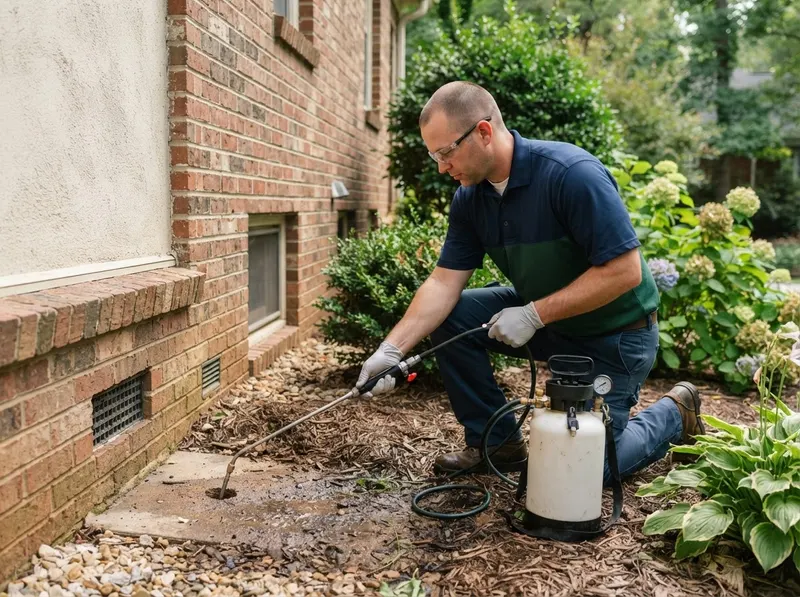
Subterranean termites account for the vast majority of structural timber damage in North Georgia. In historic neighborhoods like Inman Park, Grant Park, and Virginia-Highland, older continuous brick or stone foundations frequently feature unseen settlement cracks that grant subterranean foragers direct access to sill plates. Modern slab-on-grade construction in Old Fourth Ward and Midtown encounters different vulnerabilities, specifically plumbing penetrations and expansion joints concealed beneath flooring. Termite control creates an unbroken defensive envelope around these entry points using non-repellent liquid termiticides or low-profile exterior bait stations placed at 10-to-12-foot intervals along the perimeter footprint.

Selecting between a liquid perimeter barrier and a baiting system depends entirely on soil configuration and architectural design. Liquid perimeter treatments require trenching 6 inches deep by 6 inches wide along foundation walls and rod-injecting termiticide down to the footer; this method fits homes with accessible perimeters in Collier Hills and Buckhead Forest. However, properties with extensive concrete decking, mature root networks from protected canopy oaks, or zero-lot-line walls in Cabbagetown benefit more from baiting matrices. The trade-off centers on disruption versus onset speed: liquid barriers deliver immediate local exclusion within 30 to 90 days, whereas baiting systems rely on worker termites distributing insect growth regulators throughout the subterranean network over several months to collapse the primary queen.

Effective colony eradication eliminates internal baseboard spraying, which merely repels worker termites to alternate joists and prolongs hidden destruction. Subterranean workers require continuous contact with moist soil to survive, traveling through shelter tubes built across foundation walls. When these tubes breach sill plates or band joists, the resulting damage compromises the load-bearing integrity of floor systems. Treatments focus heavily on damp-soil interfaces: crawlspace piers, basement walkouts, back-filled porches, and perimeter red clay soil adjacent to garden beds. Property assessments verify construction type, linear footage, and subterranean moisture pockets without demanding multi-year binding commitments up front.

Termite Control cost in Atlanta

Localized Spot Treatment (Crawlspace Pier or Single Wall)$250 - $475
Standard Perimeter Liquid Treatment (150-200 Linear Feet)$850 - $1,650
Large Home or Complex Foundation Liquid Barrier (200+ Linear Feet)$1,500 - $2,800
Perimeter Baiting System Installation (Full Perimeter)$950 - $1,800
Annual Structural Re-Inspection & Station Monitoring$250 - $375/year

Every job gets a firm, written price after a free on-site visit.

Common questions

What makes subterranean termites so aggressive in Atlanta?
Subterranean termites thrive in Atlanta due to the combination of warm ambient temperatures, high relative humidity, and porous Georgia red clay soil that retains subterranean moisture near foundation walls.
How does foundation type impact termite treatment costs across Atlanta?
Foundation architecture dictates the necessary labor and materials: homes built on monolithic slabs require targeted slab drilling around interior plumbing runs, whereas elevated crawlspace homes in neighborhoods like West End require trenching around every supporting pier, altering the overall linear footage.
Are perimeter termite barriers hazardous to indoor air quality or pets?
Perimeter non-repellent liquids bond directly to outdoor soil particles below ground level, leaving no airborne residue inside living quarters, attics, or heating ducts.
How can an Atlanta homeowner distinguish flying termites from ant swarmers?
Swarming termites have straight, bead-like antennae, thick uniform waists, and two pairs of equal-length wings that shed easily, whereas flying carpenter ants feature elbowed antennae, cinched waists, and unequal wing sizes.
Does homeowner insurance in Atlanta cover structural repairs from subterranean termites?
Standard home insurance policies across Georgia exclude subterranean termite damage, classifying wood consumption as preventable maintenance rather than sudden structural failure, which makes active perimeter defenses essential.
Helpful resources

Trusted references & local links

USA.gov, government & consumer helpBetter Business BureauFTC Consumer AdviceU.S. Small Business AdministrationReady.govU.S. EPAENERGY STARU.S. Dept. of EnergyConsumer.govU.S. Census BureauGoogle Maps, Atlanta, GA

Get started today

Tell us about your termite control job in Atlanta and we'll send a clear, written quote, usually the same day.

Get your free Pest Control Service quote, Atlanta

We only use your ZIP to check availability, no spam.