Residential ant pressures in Atlanta are driven primarily by tree cover and moisture retention. In historic neighborhoods such as Inman Park, Virginia-Highland, and Grant Park, mature oak canopies deposit organic…
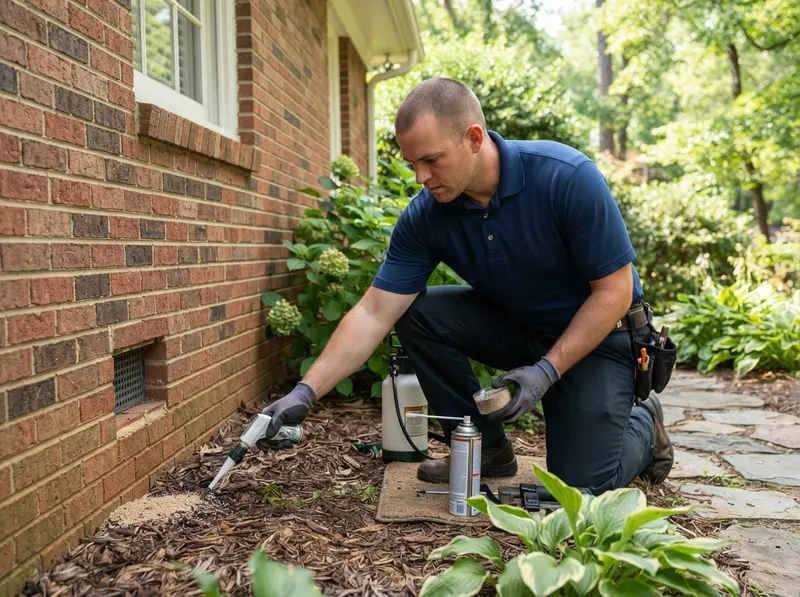
Residential ant pressures in Atlanta are driven primarily by tree cover and moisture retention. In historic neighborhoods such as Inman Park, Virginia-Highland, and Grant Park, mature oak canopies deposit organic debris against stone foundations and rooflines. This creates direct bridges for Argentine ants (*Linepithema humile*) and carpenter ants (*Camponotus*). Standard retail contact sprays fail against these species because fast-acting repellents cause colony budding, a defensive behavior where a single supercolony splits into multiple satellite nests within drywall voids and behind subfloor framing. Effective eradication requires slow-acting, non-repellent transfer chemistries. Foraging workers pick up micro-doses on their cuticles and distribute the active ingredient through trophallaxis (food sharing) directly to the queen.
In high-density structural corridors like Midtown, Old Fourth Ward, and Cabbagetown, multi-unit brick masonry and crawlspace humidity allow odorous house ants to establish nesting zones behind bathroom fixtures and kitchen cabinetry. If an infestation consists of carpenter ants excavating damp structural wood in crawlspaces in Collier Hills or West End, targeted moisture mitigation and systemic wood injection are required rather than simple perimeter liquid bands. Conversely, Argentine ant supercolonies spanning multiple properties in Buckhead Forest or East Atlanta Village require wide 10-foot band treatments across mulch beds, pine straw, and foundation perimeters to intercept foraging lines before they breach door thresholds.
Interior treatments are conducted using low-volatility, targeted bait matrices positioned within wall voids and concealed electrical chase ways, eliminating chemical drift in clean living or cooking spaces. The trade-off between exterior perimeter defense and interior broadcast spraying is longevity versus immediate visible knockdown: surface sprays kill visible foragers instantly but leave the reproductive queen intact, whereas exterior perimeter non-repellents require 7 to 14 days to fully extinguish the subterranean nest while preventing chemical exposure to domestic animals inside the home. Every treatment is designed around home construction vulnerabilities, terminating active ingress points along sill plates and masonry joints.
Every job gets a firm, written price after a free on-site visit.
Tell us about your ant control job in Atlanta and we'll send a clear, written quote, usually the same day.
 PestSentry Pest Control