Stinging insect control in Atlanta properties requires clinical structural intervention rather than surface-level pyrethroid spraying. In mature tree canopies across Collier Hills, Virginia-Highland, and Buckhead…
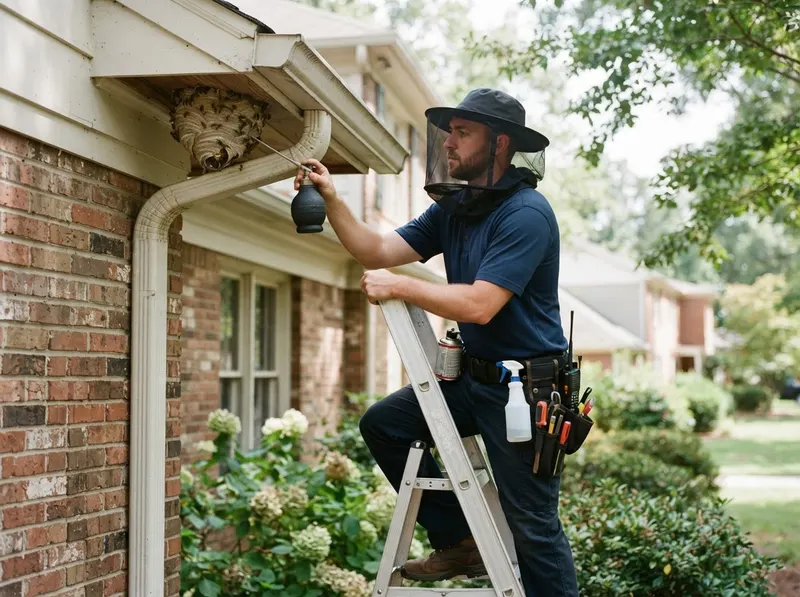
Stinging insect control in Atlanta properties requires clinical structural intervention rather than surface-level pyrethroid spraying. In mature tree canopies across Collier Hills, Virginia-Highland, and Buckhead Forest, aerial hornets and yellowjackets build nests beneath high soffits, within chimney chases, and inside uncapped fascia boards. Standard consumer aerosols frequently fail because they trigger an alarm pheromone response, scattering agitated foragers outward without penetrating the central brooding core. Effective eradication demands directional injection of micro-encapsulated formulations or dry insecticidal dust directly into the primary entrance aperture, collapsing the colony matrix from within.
Decision-fit depends on nest location and structural access. A surface-attached paper wasp comb beneath an Inman Park front porch demands localized physical removal and residual barrier treatment. Conversely, a subterranean yellowjacket colony excavated in a Grant Park lawn or an aerial yellowjacket nest concealed inside an Old Fourth Ward brick veneer requires specialized pressure delivery to saturate the internal gallery. If a nest is located inside finished drywall, external directional dusting prevents workers from chewing inward into living quarters. Homeowners balance immediate physical extraction against complete pharmacological collapse: leaving a treated, inaccessible nest within a sealed cavity for 48 hours ensures returning field foragers come into direct contact with the residual active ingredient.
Historic home architectural elements throughout Midtown, Cabbagetown, and the West End present unique void vulnerabilities. Porch tongue-and-groove ceilings, open eave brackets, and attic gable vents provide unmonitored access for queen wasps seeking overwintering shelter in late autumn. Stinging insect management addresses these entry thresholds by coupling direct eradication with physical mechanical exclusion. Technicians apply stainless-steel wire mesh across gaps greater than 0.25 inches and seal decorative trim joints with silicone-based elastomeric caulking to eliminate recurrent colonization cycles throughout Fulton County.
Every job gets a firm, written price after a free on-site visit.
Tell us about your stinging insect management job in Atlanta and we'll send a clear, written quote, usually the same day.
 PestSentry Pest Control